Amazon – Qualcomm Agreement
Cross-Perspectives of Value Creation

By Dominique Jacquet
In the June vidcast, we analyzed the “industrial-financial” agreement between NVIDIA and Corning in which the latter secured the former’s supplies by strengthening its equity in order to finance the investments necessary for production. The agreement contributing to Corning’s value creation was built around NVIDIA’s holding of warrants allowing it to capture part of the value created with its preferred supplier.
This type of agreement appears particularly relevant in the world of AI and uncertainty, and Amazon, which has been a continuous user of these partnership contracts for 10 years (2016, air freight, Atlas Air), has just concluded two partnerships, one, quite classic with Generac Holdings (supply of electrical generators for data centers), the other, very “systemic” with Qualcomm.
I will focus on the second.
For 10 years, Amazon will buy Qualcomm’s products (chips, processors, IoT systems, etc.) and the turnover generated by Qualcomm will serve as a vesting process (acquisition of rights) with a revenue ceiling of $60bn. Concretely, the more products Amazon buys, the more it receives warrants covering a total number of 25 million shares at a strike price of $161.26. The agreement is announced on September 8, 2026
When the contract was signed, 3.75 million rights were already acquired, or 15% of the total.
This contract must be analyzed from different and complementary angles.
Financial metrics of warrants
Warrants are call options and Amazon will only generate financial gains if it exercises the options, i.e. if the price is higher than the exercise price.
Over the last 12 months, Qualcomm’s price has shown some volatility, as evidenced by the following graph…
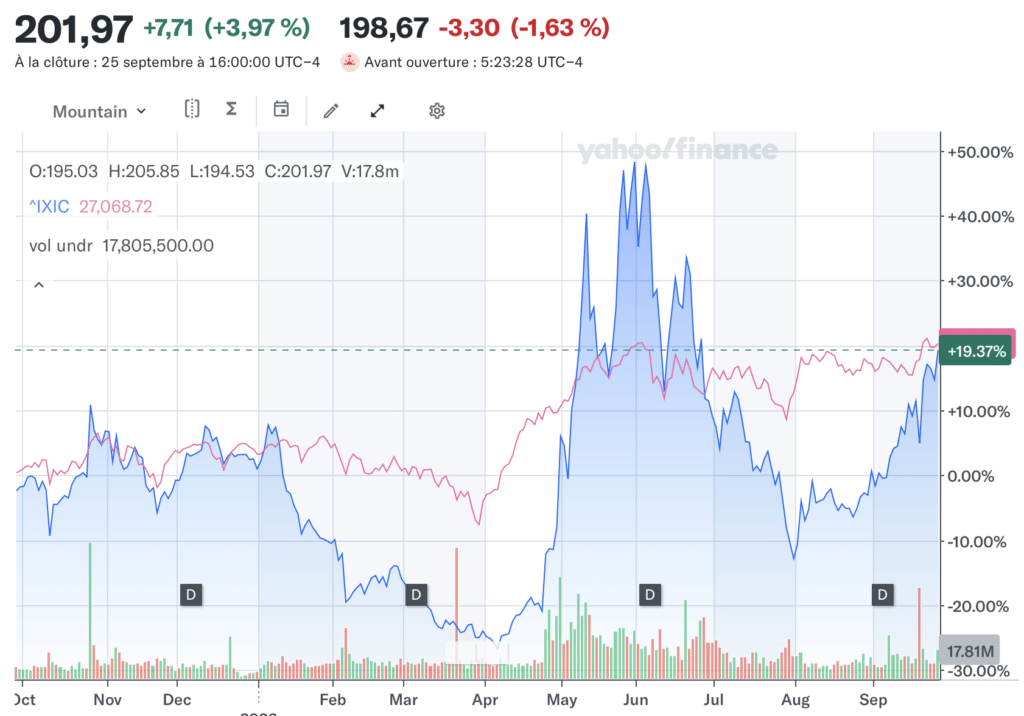
Qualcomm’s price followed the Nasdaq over a year, but varied greatly in an interval [$120; $260]. The day before the announcement, the price stood at $169, so the option is slightly “out of the money”, but the announcement will immediately have a positive impact on the price which will close at $174 on September 8.
At that time, Amazon has (initial vesting) the capacity to purchase 3.75 million shares at $161 while they are listed at $174, representing a unit gain of $13 and a total potential capital gain (intrinsic value of the options portfolio) of $49M.
At the time of writing this blog, the price reached $202, so the intrinsic value amounts to $154M.
Intelligently, Amazon waited for a downward correction in the stock to make the partnership a reality.
Discount or warrant?
The mutual interest of the two parties is quite obvious: one secures its supplies, the other its revenues, so there is a double creation of value.
Traditionally, when a client commits to volumes, he negotiates a discount, a rebate, which, in this specific case, is transformed into warrants whose exercise price is close to the stock market price. We say that the option is then “at-the-money” so Amazon will receive options whose intrinsic value is, initially, zero, but the time value is correlated to the volatility of the underlying asset and, above all, to the development potential of Qualcomm whose strategic ambitions are consolidated by the agreement.
In summary, the rebate is the time value of the option.
Unlike the NVIDIA-Corning case, Amazon receives the options, but does not buy them. NVIDIA had paid $500M for the portion of the options with a negligible exercise price, which allowed Corning to have the funds to invest. In the Amazon-Qualcomm case, Amazon will perhaps exercise the options (generally at maturity) providing funds to Qualcomm, but the latter can very well buy back the warrants from Amazon at maturity for their intrinsic value if the firm has the funds and wishes to limit shareholder dilution.
Now the question arises of accounting for warrants in Qualcomm accounts.
Warrants in the P&L
The accounting of stock options was the subject of “lively” discussions, with accounting authorities considering that the granting of options to employees was a substitute for salary and should be recognized as an operating expense (SBC: Stock-Based Compensation), which led high-growth listed companies to produce an Adjusted EBITDA considering that SBC is an investment of key employees, and not a salary…
What happens when a client receives warrants?
The accounting rule consists of treating this warrant as what it is from an economic point of view, namely a rebate, therefore a reduction in turnover (ASC 606 and 718).
A negative impact on revenues translates into the same impact on operating income because the contract has no impact on operating expenses. In addition, after calculating the net profit attributable to the group’s shareholders, we divide this last figure by the number of shares in circulation, then by the number of shares after speculative dilution in order to communicate two indicators: Earnings Per Share (EPS), actual and diluted.
The granting of warrants amplifies speculative dilution, therefore reducing EPS after dilution.
Taking a static view, the contract penalizes diluted EPS in two ways, by reducing operating profit and increasing the number of speculative shares.
On the other hand, revenues will be accelerated for two reasons: on the one hand, the agreement itself which guarantees revenue growth, on the other hand, the positive effects induced on Qualcomm’s development strategy (economies of scale, integration of technological roadmaps, commercial and technical credibility, acquisition of skills, etc.).
As there are short- and medium-term impacts on key performance indicators, it is important to consider executive remuneration to identify the consequences of the agreement and their financial motivation.
Agreement, performance plan and leaders
Qualcomm executives receive fixed compensation, variable compensation and stock awards.
Variable compensation is based on adjusted revenue and adjusted operating profit, not EPS. Interestingly, the two “classic” metrics for measuring financial performance (ROCE and FCF) are absent.
So, the granting of warrants will reduce revenues after rebates and the adjusted EBIT of revenues generated with Amazon.
But we can consider that this is quite marginal compared to the acceleration of revenue generated by the contract.
In addition, most of the remuneration of executives comes from the granting of shares whose rights vest in the medium term depending on the evolution of the stock price (TSR relative to the market) and performance (adjusted EPS).
If the agreement leads to real economic dynamics, the financial impact for managers will therefore be very positive.
What about for “other” shareholders?
Is the contract a win-win for shareholders?
If Qualcomm’s stock price rises to $500, Amazon will earn the difference between 500 and 161 multiplied by 25 million shares, or $8.5 billion, which is considerable.
Certainly, but at the same time, revenues will have increased by 60 billion dollars. Qualcomm’s EBITDA is of the order of 27% of turnover, hence an increment in EBITDA of 16 billion USD and, with a number of shares in circulation of around one billion, the market capitalization will have increased by 340 billion USD, which allows us to conclude a sort of win-win…
Amazon secured its supplies, shared Qualcomm’s technological trajectory and made a lot of money. Shareholders, too…
Two concluding remarks:
- In a world dominated by ruptures and uncertainty, the construction of agreements based on cooperative games is a source of shared value
- The role of finance (financial and legal engineering) in supporting industrial strategy is critical.